
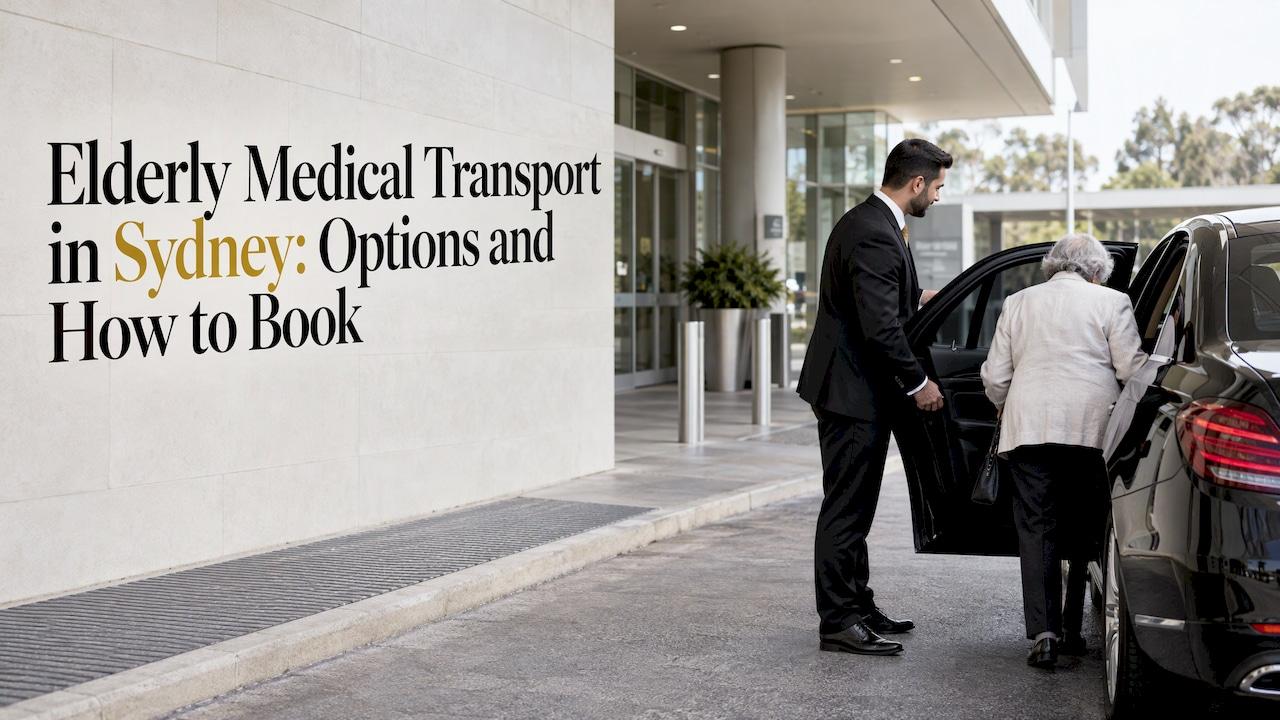
Older Australians have three main ways to get to a medical appointment without driving: government-funded or community transport, ambulance patient transport for people who need clinical care on the way, and privately booked rides. This guide explains how each works, who qualifies, how much notice to give and what to tell the booking office. It also shows where our wheelchair accessible and medical rides in Sydney fit, so you can book with confidence.
TL;DR
- If an older person needs help getting to appointments but no medical care during the trip, community transport, aged care transport or a private door-to-door ride can all fit. Which one suits depends on eligibility, timing and flexibility.
- Subsidised transport usually depends on an assessment or eligibility criteria, and it often needs days of notice. Check the rules before you rely on it for a fixed appointment time.
- Ambulance transport is for people who need active clinical monitoring or supervision on the trip, and it needs authorisation from a health professional.
- Our 24/7 service in Sydney offers fixed pricing, wheelchair accessible rides, baby seat vehicles for family members travelling along, and NDIS and medical transport.
- Before booking, have the appointment time, address, mobility aids and any carer travelling ready. It makes the whole process quicker.
Table of Contents
- The main ways older people get to appointments
- Subsidised and community transport: who qualifies
- What aged care transport does and does not cover
- When an ambulance is needed instead
- How much notice to allow
- What to have ready before you book
- Mobility, wheelchairs and door-to-door help
- Our perspective
- Booking a ride with us in Sydney
- A simple plan for family members arranging transport
- FAQ
- Sources
The main ways older people get to appointments
Missing a specialist appointment because the ride fell through is stressful for everyone. Knowing the categories helps you choose the right one the first time.
Aged care transport. My Aged Care describes a Transport service for older people that can be direct, with a car and driver, or indirect, through taxi or rideshare vouchers. It may be delivered through the Commonwealth Home Support Program, Support at Home or Transition Care, and an aged care assessor determines eligibility.
Community transport. MyGov says community transport providers operate in most states and territories for people with limited transport options or difficulty accessing transport. In New South Wales, Transport for NSW explains that community transport may be available to people who meet eligibility criteria, and that it can include door-to-door trips and wheelchair-suitable vehicles.
Non-emergency patient transport. Some states run patient transport through their ambulance services for people who need care or monitoring during the journey. We cover this below, because it is a different thing from a ride with a driver.
Private door-to-door rides. A privately booked taxi or chauffeur ride is paid by the passenger, family or, in some cases, a funding arrangement the person already has. The appeal is simple: you choose the time, you book directly, and you are not waiting on an eligibility decision. This is the category we work in.

Many families use a mix. A subsidised service might cover a regular weekly trip, while a private ride handles the short-notice specialist booking, the early-morning procedure or the return trip that runs late.
Subsidised and community transport: who qualifies
Rules differ by state, by provider and by funding source, so treat the following as a guide to the questions to ask rather than a promise of what you will receive.
Transport for NSW lists the kinds of people community transport can help, including elderly people with limited mobility, people with a disability or health issue that limits mobility, people with language challenges, and people with little or no public or private transport.
A regional NSW example shows how funding sources shape eligibility. Snowy Monaro Regional Council explains that its community transport eligibility comes from several funding sources, including the Commonwealth Home Support Program for people aged 65 and over (50 and over for Aboriginal and Torres Strait Islander people) and the Community Transport Program for people who are transport disadvantaged or live in rural and remote areas with little or no public transport.
In Victoria, the Better Health Channel notes that eligibility and booking criteria differ between providers, and some services are free while others charge. It also says community transport suits people who need help getting to an appointment but do not need medical supervision or care while travelling.
Queensland's program adds another example. Its Community Transport Program eligibility includes being under 65, having no or limited access to other transport, and not receiving transport for the same or a similar purpose under another government scheme.
What this means in practice:
- Eligibility is often tied to an assessment, an age bracket or a location.
- Providers set their own booking rules and costs.
- A subsidised trip is usually arranged ahead, so it suits routine appointments better than last-minute ones.
If the person you are helping does not fit a program, has used up their allocation, or needs a trip at a time the program cannot offer, a private ride gives you a straightforward alternative.
What aged care transport does and does not cover
It helps to know the limits before you plan around a funded service. My Aged Care states that its Transport service does not include general expenses such as licence costs, car running costs, public transport costs or holiday travel.
MyGov also notes that most states and territories offer discounted public transport for seniors and pensioners, and some offer discounts on other transport options. Public transport concessions are useful for people who can manage stations, stops and steps. For someone with limited mobility, or on a day when they are unwell after a procedure, door-to-door is a different level of comfort.
When an ambulance is needed instead
This is the line families most often get wrong. A wheelchair accessible taxi or chauffeur ride is for passengers who do not need clinical care on the trip. If a doctor says your relative needs monitoring or care while travelling, that is a patient transport matter.
Victoria's ambulance payment guidelines state that ambulance transport can only be used when clinically necessary, meaning the patient requires active clinical monitoring or care, or clinical supervision, during transport. The same guidelines limit authorisation to health professionals who can judge genuine clinical need, including a registered medical practitioner and, under the Non-Emergency Patient Transport Regulations 2016, a registered division 1 nurse.
Queensland shows what the booking side can look like. Queensland Ambulance Service non-emergency transport needs at least 24 hours' notice and details such as the medical condition, pick-up and destination, the authorising doctor, special care needs and return-trip requirements. Other states have their own arrangements.
If you are unsure which side of the line your relative is on, ask their GP or the specialist's rooms. They can tell you whether the person needs clinical supervision or just a safe, comfortable ride. If there is any emergency, such as chest pain, sudden weakness or difficulty breathing, call 000.
How much notice to allow
Notice is where subsidised services and private rides differ most.
Snowy Monaro Regional Council advises phoning as soon as the appointment date and time are known. It asks for at least two working days before trips to Canberra or Bega and 24 hours before local regional trips, with no guarantee if you book later. Queensland's non-emergency ambulance transport asks for at least 24 hours, as covered above.
A sensible habit is to book the ride the moment the appointment is confirmed, whichever service you use. For private rides, that also means your preferred time is locked in. We run 24 hours a day, so early starts for day procedures and late returns are part of the normal job rather than a special request.
What to have ready before you book
Whether you call a community transport office or a private operator, the same details speed things up. Snowy Monaro's guidance lists what people booking should provide: appointment time and address, the specialist or facility name, any procedure, the expected length of the appointment, and whether a partner, friend or carer will travel.
We suggest adding a few practical items:
- Pick-up point. Include the unit or gate number, and mention any steps, a steep driveway or a lift.
- Mobility aids. Say whether the passenger uses a wheelchair, walker or frame, so the right vehicle is sent.
- Who is travelling. A carer, a family member or a grandchild with a baby seat changes the vehicle choice.
- Return time. Appointments run over. Give a rough window, and tell us if the return trip will be open-ended.
- Contact on the day. Give the number of someone who can answer if the passenger is hard to reach or hard of hearing.
- Funding. If the trip is under an NDIS plan or another funding arrangement, mention it when booking.
Mobility, wheelchairs and door-to-door help
For many older people, the car ride is the easy part. Getting from the front door to the car and from the drop-off to the clinic is the hard part.
Transport for NSW notes that community transport can include door-to-door service, vehicles suitable for wheelchairs and specific mobility needs, and trained drivers who can assist passengers to and from the vehicle. Those are the right things to look for from any provider.

Our service includes wheelchair accessible rides, and our drivers are local experts, which matters when the hospital has three entrances and only one is close to the clinic you need. Tell us at booking what the passenger needs at each end, so we can plan the pick-up and drop-off properly.
A few tips from the family side:
- Allow extra time at both ends. Rushing is how falls happen.
- Bring the referral, Medicare card, medication list and any imaging the appointment needs, and keep them in one bag.
- If your relative tires easily, plan the return trip for straight after the appointment and not after a long wait.
- For multiple appointments in a day, such as pathology then a specialist, consider hourly hire so the same driver can stay with the plan.
Our perspective
We hear the same story from families again and again. The appointment is booked weeks ahead, the ride is arranged, and then something shifts: the clinic runs late, the booking window is missed, or the person simply cannot manage a bus and two changes.
Our approach is to take the stress out of the trip itself. We are available 24/7, with fixed pricing so there are no hidden fees, which matters when a family is already worrying about a diagnosis or a procedure. Our fleet is modern and well maintained, our drivers are professionals who know Sydney, and we offer wheelchair accessible rides and NDIS and medical transport so the vehicle matches the person.
We think an older passenger should be treated as a person with a schedule and a preference, not a booking reference. That means a driver who is on time, a vehicle that is comfortable to get into, and a family who can call and speak to someone. Our customers have rated us 4.9 on average across more than 10,000 trips, and the consistency behind that number is what we work hardest at.
Funded and community programs do valuable work, and many families use them for regular trips. When you need a specific time, a short-notice slot or an extra pair of hands on a busy day, a direct booking with us fills that gap.
Jibran
Booking a ride with us in Sydney
Our medical and appointment rides cover older passengers, people with disability and families across Sydney, including airport and hospital runs and hourly hire for a day of appointments. You can book online or by phone, and the price is fixed at booking.
What we can arrange for a medical appointment:
- Wheelchair accessible rides for passengers who stay in their chair or need space for a mobility aid
- NDIS and medical transport for eligible participants
- Group and maxi taxi options when family members or a carer travel along
- Vehicles with baby seats when a grandchild is coming too
- Hourly hire for a day of back-to-back appointments
- Corporate accounts for aged care providers, clinics and employers who arrange recurring transport

See our services for the full list, look at our fleet to choose a vehicle, or book your ride online when you have the appointment details.
A simple plan for family members arranging transport
If you are coordinating this for a parent or grandparent, work through these steps in order.
- Ask the GP or specialist about clinical needs. Confirm whether the person needs any care or monitoring on the trip. If so, that is a patient transport conversation. If not, the options above apply.
- Check funded options first for regular trips. Call My Aged Care or the local community transport provider to ask whether your relative is eligible and what notice is needed.
- Fill the gaps with direct bookings. For appointments outside provider hours, short-notice slots or days with several stops, book a private ride.
- Confirm the details a day ahead. Check the pick-up time, the address and who is travelling.
- Keep a record. Note the booking, the driver and any issues, so the next trip runs even more smoothly.
FAQ
What is the best transport for an elderly person without a car?
The right choice depends on mobility, budget and timing. Community and aged care transport suit regular trips if the person is eligible, while a private door-to-door ride suits flexible times and short-notice appointments. Many families combine both.
Can an elderly person get free transport to medical appointments?
Some can. Community and aged care transport may be free or low cost depending on the provider and the person's eligibility, and the Better Health Channel notes some services charge while others do not. Contact My Aged Care or your local provider to find out what applies.
Do you offer wheelchair accessible rides for medical appointments?
Yes. We offer wheelchair accessible rides in Sydney, and we also provide NDIS and medical transport. Mention the wheelchair or mobility aid when you book so we can send the right vehicle.
How far ahead should I book?
Book as soon as the appointment is confirmed. Subsidised services often need a day or more of notice, and some give no guarantee if you ring later. We operate 24/7, so you can book at any hour.
When should I call an ambulance instead of booking a ride?
Call 000 in an emergency. For planned trips, an ambulance or patient transport service is for people who need clinical monitoring or care while travelling, and a doctor or other authorised health professional decides that. If no clinical care is needed on the trip, a wheelchair accessible or door-to-door ride is the right fit.
Sources
- Transport | My Aged Care
- Transport as you get older | myGov
- Community transport | transportnsw.info
- Community Transport Program | Snowy Monaro Regional Council
- Community transport providers | Better Health Channel
- Transport assistance | qld.gov.au
- Non-emergency medical transport | qld.gov.au
- Ambulance services payment guidelines | Victorian Department of Health